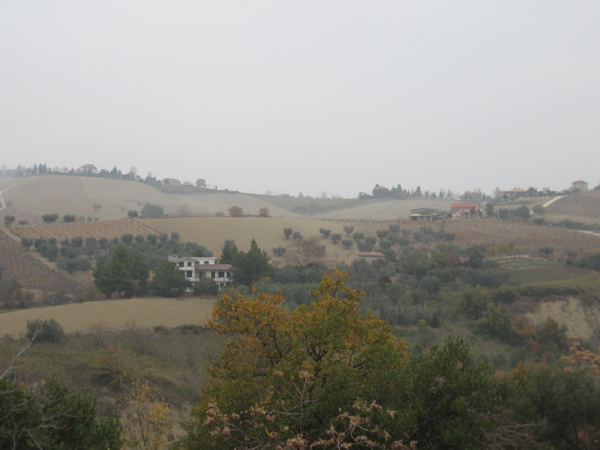
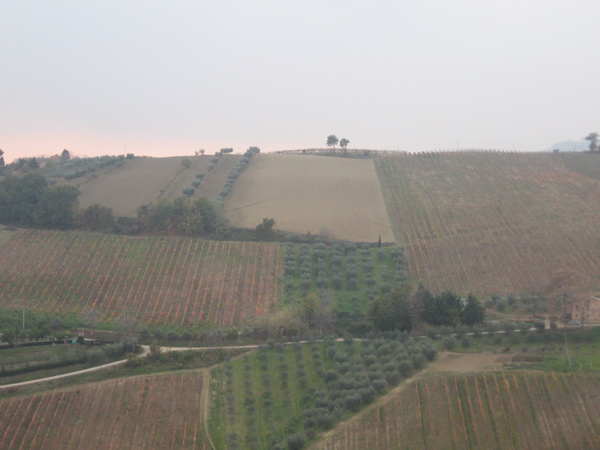
For today’s post we’re taking a drive about 3 hours northeast of Rome, to a little town in the region called Le Marche. The name of the town, Offida, is believed to have come from the Latin word “ophis” meaning snake, because supposedly there was a pagan cult here that worshipped a golden snake, and legend has it that it is buried beneath the majestic church Santa Maria della Rocca.
Perhaps you’re wondering how I ended up in such a small town not far from Ascoli-Pisceno, near the Adriatic coast. Alessandro and I have a friend who recently moved there when he became a notaio. Now, I’m not going to take up time today talking about what a notaio is, how you become one, or any of the thousand other things I could say about it. Ale is in the running to become one as well, and that’s why we know a couple friends who have recently moved out of Rome to start up their practices. I say “in the running” because it’s not a career you can choose—you have to go through a Byzantine-like ritual of examinations that take several years to complete, and as with many things in Italy, simply following the rules, studying and doing a good job on the exam doesn’t necessarily guarantee you a spot. In any case, Ale has promised that one of these days he will be a guest blogger for me because he wants to tell you all about what a notaio does, his adventures trying to become one, and those of our friend Paolo as well, who has quite an interesting story of his own.
For now though, we can enjoy the charming little village where Paolo ended up opening his office. The structure that impressed me the most was the church, S. Maria della Rocca, a former castle.
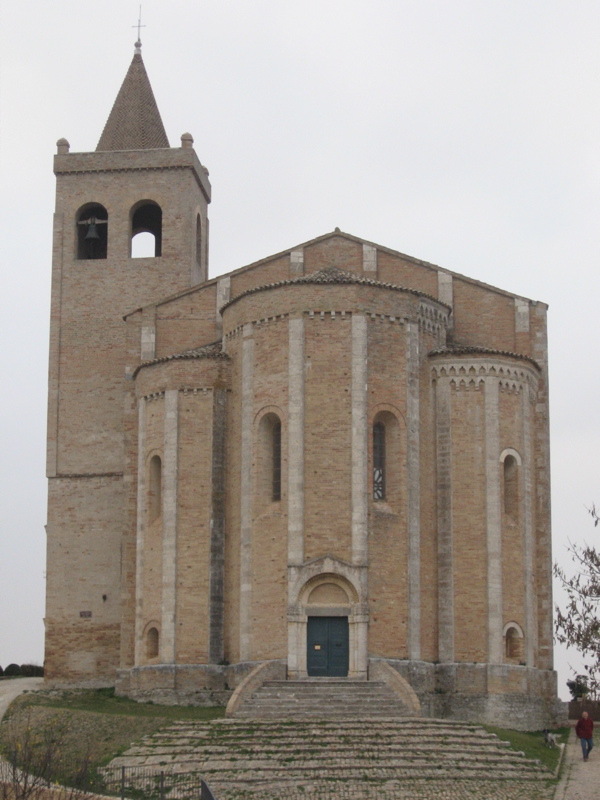
I’m not sure when it was built, but it was passed to the Benedictine monks in 1047. It’s only open to the public on Saturday and Sunday, but it turns out our friend Paolo knows the church custodian, a lively old man who gave us an incredible tour.
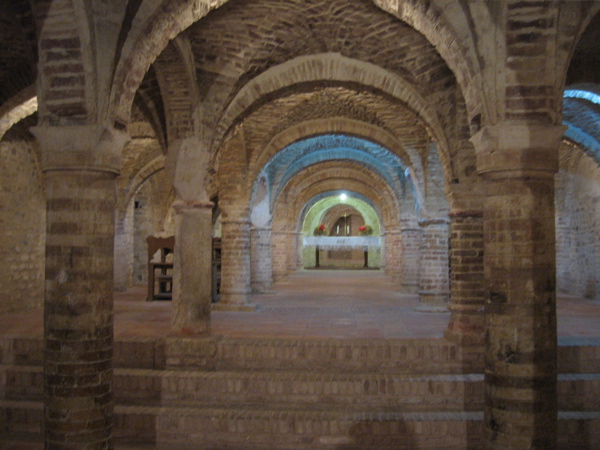
Some of the photos are dark because you can’t use a flash inside the church.
This is what you see when you first enter. It is the “lower church” or crypt, and used to be completely covered in frescoes; now only a few traces remain. Mass is celebrated here just once a year, on August 15.
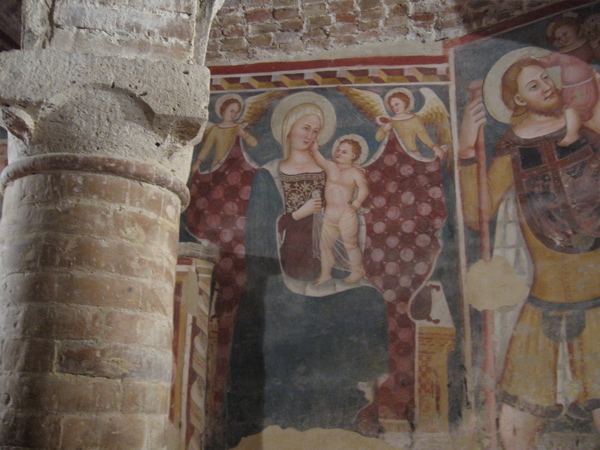
You can barely see it, but in this fresco from the 1400s, the baby Jesus is holding a bird, and the tour guide explained that oftentimes artists would use symbols to identify their works instead of signing, and the bird was this painter’s way of signing his work. To this day they don’t really know who painted it but they believe it was a monk who they refer to as the “Maestro of Offida” because of some identifying symbols and techniques in his various works.
This is the upper church and it too used to be covered with frescoes.
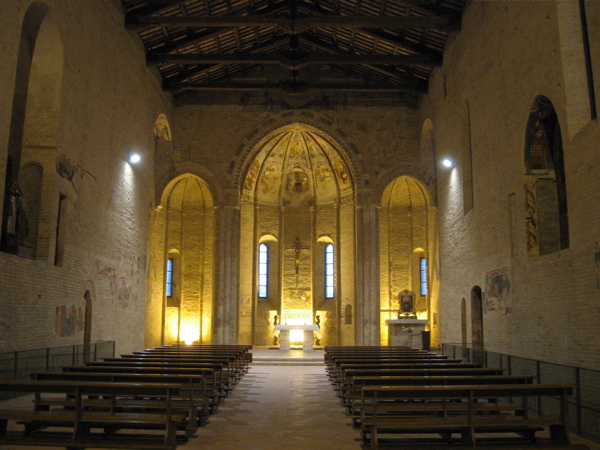
Here is some very old graffiti in the upper church, one of many phrases that was carved into the wall of the altar. Can you figure out what year it was written?

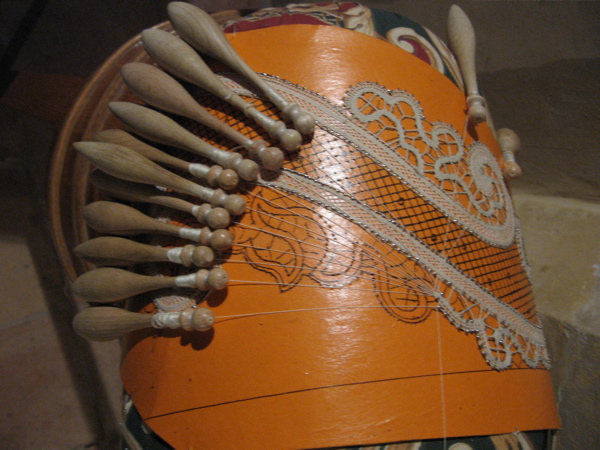
Another thing that Offida is famous for is called “merletto a tombolo” which I would translate to something like tumbler or cylinder-woven lace. At the church entrance the guide showed us a work in progress (I’m not sure who is working on it), and you can see how the pattern is placed over a sawdust-filled cylindrical pillow. The spindles are criss-crossed in order to weave the pattern and make various lace articles like doilies, tablecloths, etc.
A trip to Offida is worth the trouble if you happen to be in northeast Abruzzo or traveling northeast from Rome. It’s best with a car since it’s over 5 hours by regional train with a few connections to make as well.